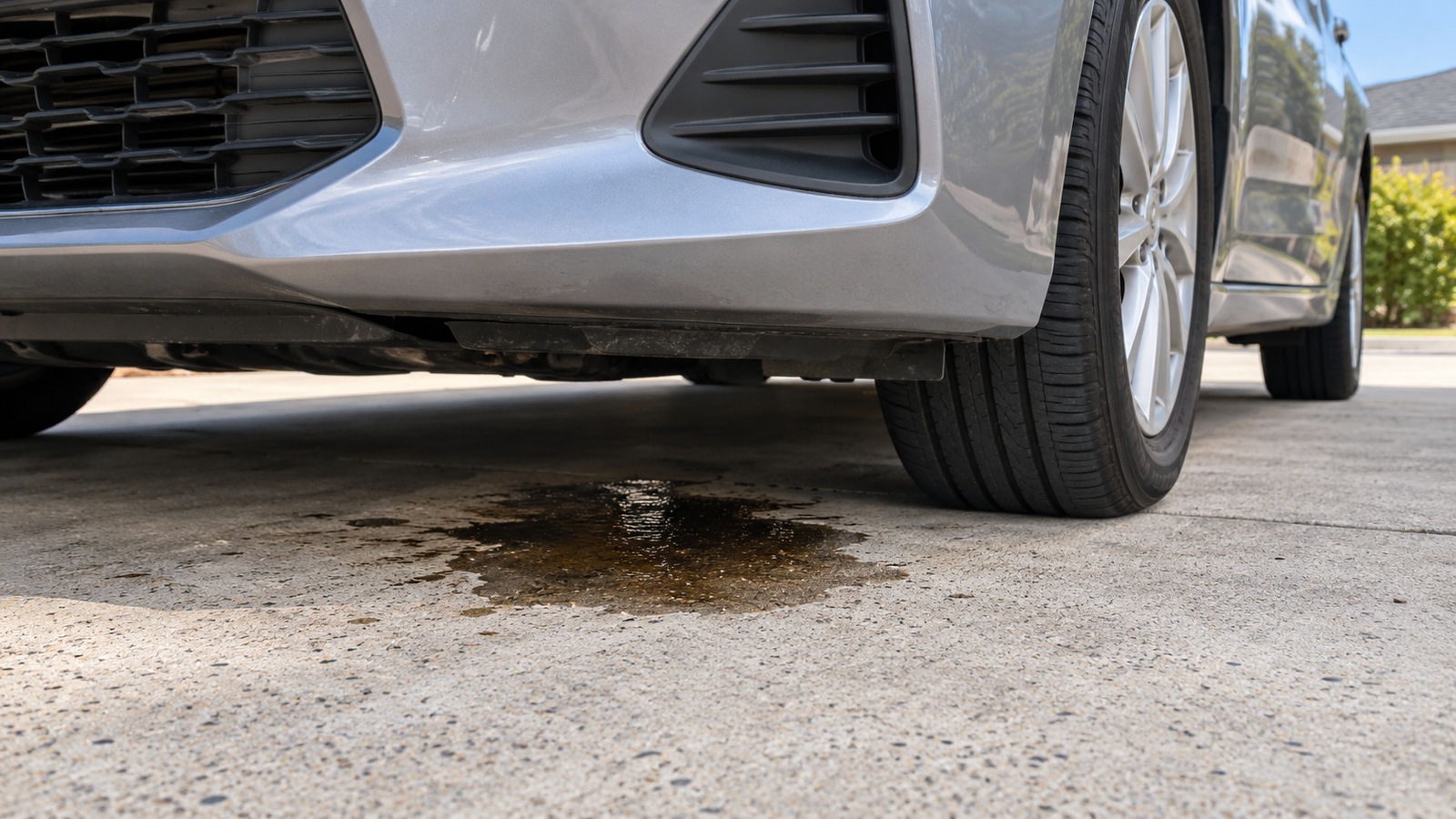
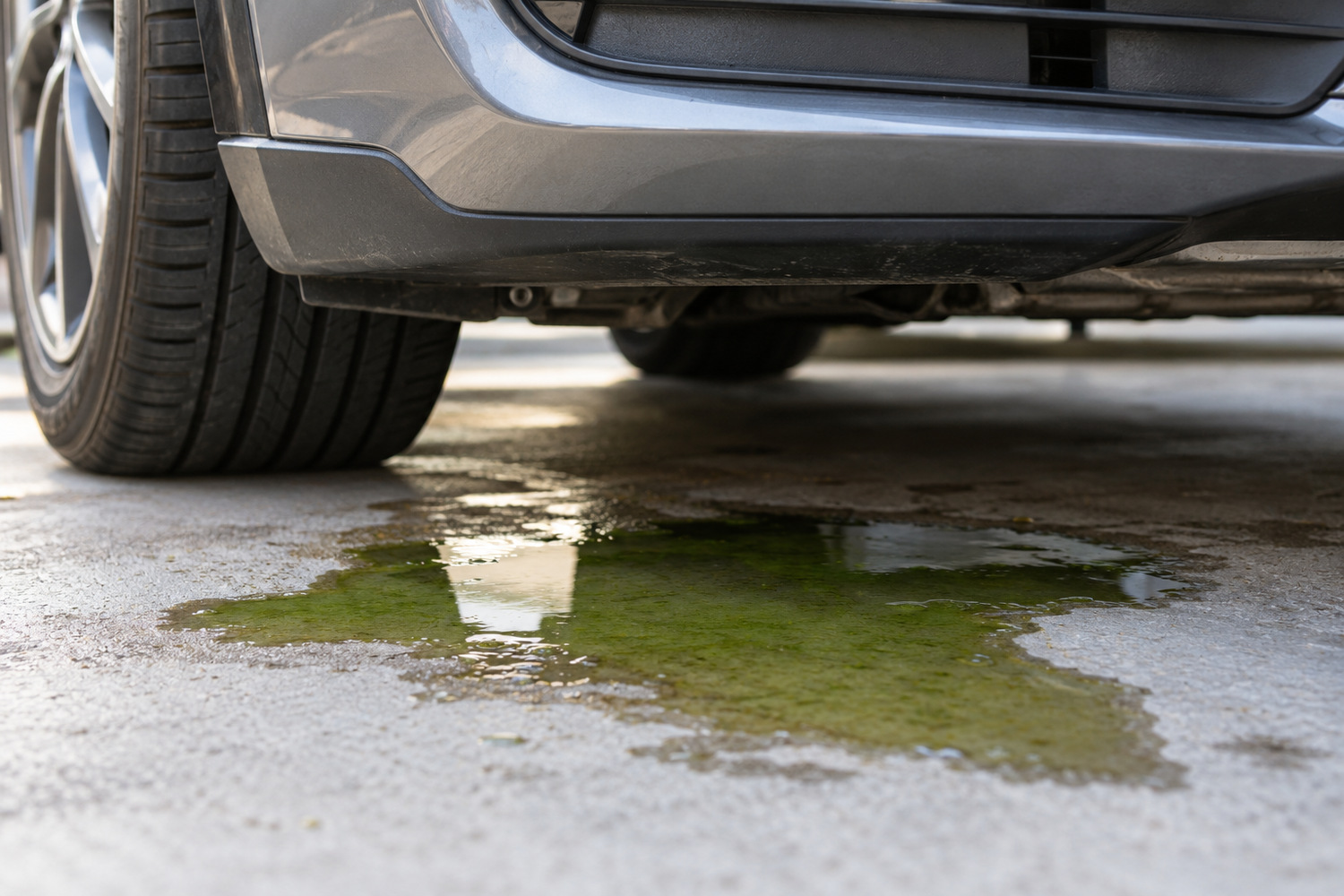
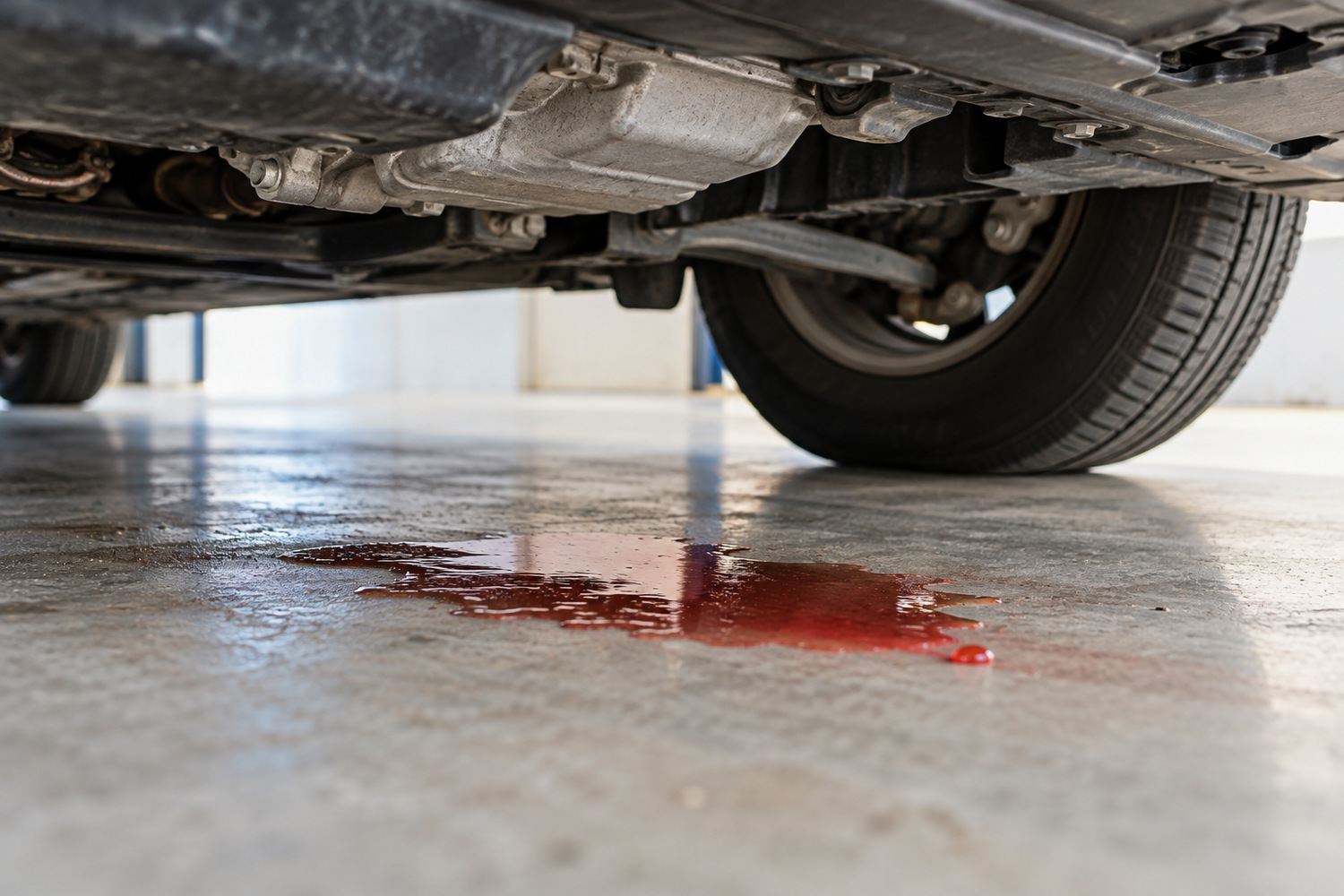
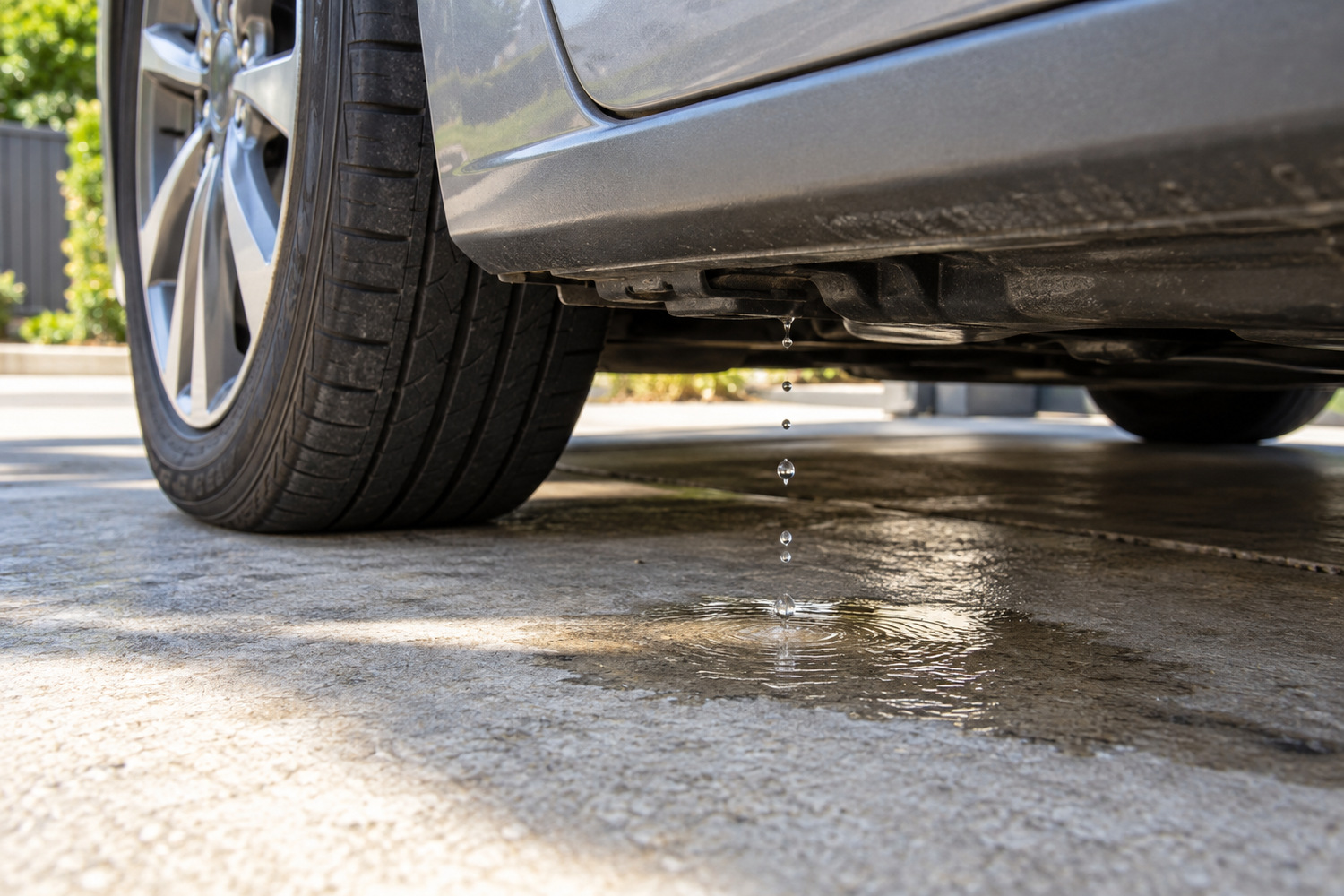
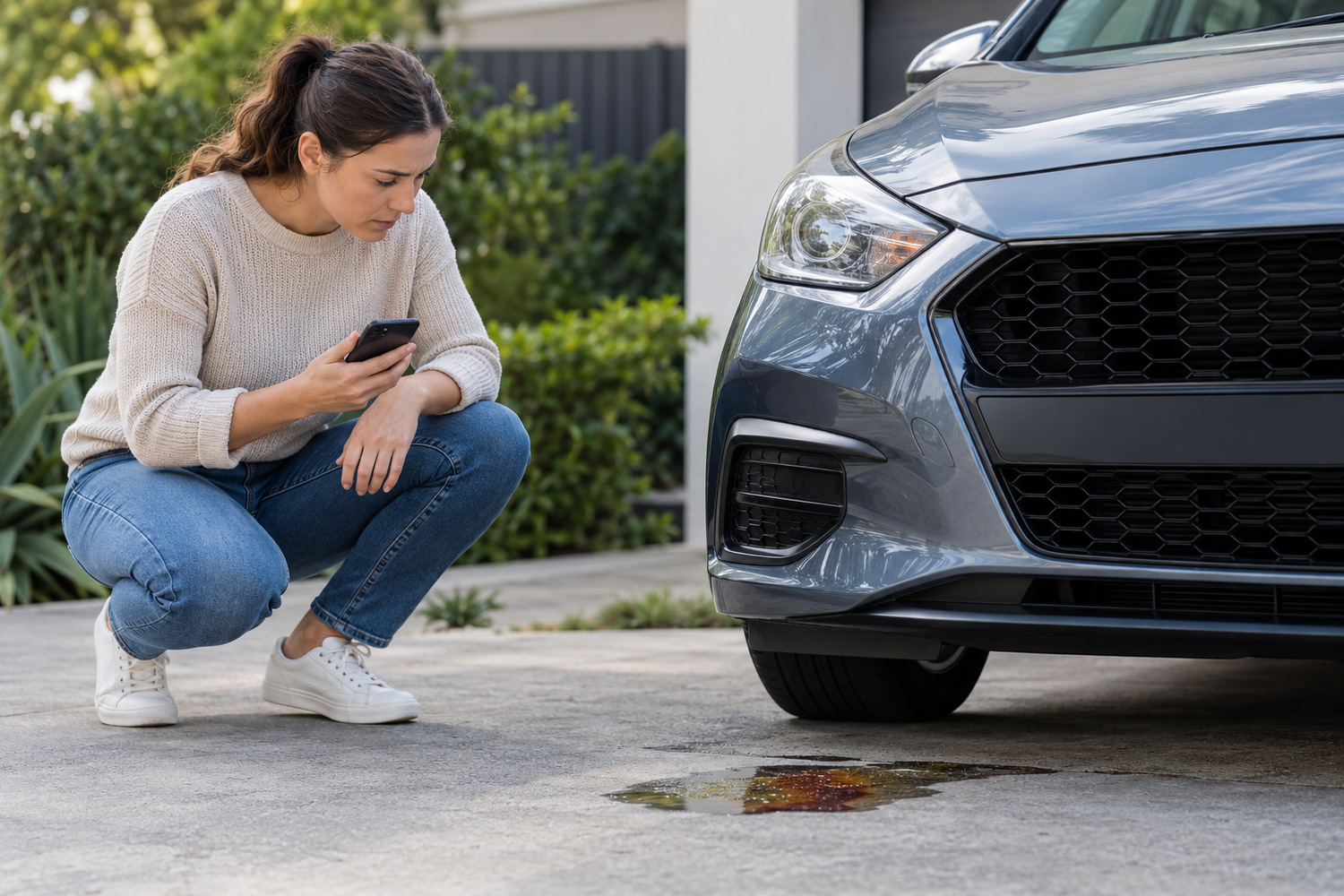
A puddle under the car is read two ways: by colour, and by where it sits. Clear water near the front on a warm day, with the air conditioning running, is almost always condensation, and nothing is wrong. Anything green, orange, red, pink or oily is worth identifying before you drive far. Colour narrows it down fast, but it does not settle it, because several fluids now share the same colours.
Around Cheltenham and the bayside suburbs most cars park on concrete, so the stain is usually what gets noticed, not the leak.
What the colour of the puddle under your car means
The colour narrows it down. The position narrows it further. Neither of them proves it. Two well-regarded Australian motoring guides disagree about two of those rows. One puts green and orange on coolant, and red on the gearbox. The other allows green or blue to be brake fluid, and red to be the cooling system. A green liquid under the car was once shorthand for coolant. It is not any more, because long-life coolants come in blue, green or red.
Coolant is the row to take most seriously. A slow leak can show as little more than a damp patch near the front of the car, so it gets missed. How small car faults turn into big repair bills covers where that ends up.
Colour and texture
Likely source
Where it usually shows
How urgent
Clear, watery, no smell
Air conditioning condensation
Front of the car, after a drive
Not a fault
Green or orange
Coolant
Front, under the radiator and hoses
Book it in promptly
Red or pink
Transmission fluid, power steering fluid, or coolant on a newer car
Further back for the gearbox, nearer the front for steering
Identify it before driving far
Brown or black, oily
Engine oil
Under the engine
Check the level, then book it in
Amber, oily, strong smell
Brake fluid
Near a wheel, or back of the engine bay
Stop if the pedal has changed
Blue
Long-life coolant, some brake fluids, or dyed screen wash
Front of the car, or a front corner
Treat it as coolant until identified
What is the red fluid leaking from my car?
Red or pink is the colour people look up by name, and a red puddle is not automatically the gearbox.
Automatic transmission fluid is generally a bright red, and it reaches the ground from a split cooler hose or the seal where a drive shaft leaves the gearbox. Power steering fluid is red too, and it tends to arrive suddenly rather than as a slow drip, because that system runs under pressure. On a newer car, red can be the cooling system.
Position does more work than colour here. Transmission fluid tends to show further back, under the middle of the car, and steering fluid nearer the front. Transmission servicing is a subject of its own, but a fresh red patch is an identification job first.
Is clear water under the car normal?
Usually, yes. Air conditioning takes moisture out of the air inside the car, and it drains onto the ground while the system runs. On a warm day that can be a respectable puddle with nothing wrong.
Three things tell it from coolant: no colour, no smell close up, and no oily feel between your fingers. It dries off concrete without a mark.
The other clear one is screen wash, from a cracked bottle or a split hose. The additive in it is dyed, so that puddle can be anything from clear to a strong colour.
Is it safe to drive with a leak?
Most leaks can be driven gently to a workshop. An old oil leak on the driveway is a booking, not an emergency. Two are different.
Do not drive it if you think it is brake fluid and the pedal has changed. Brakes work on pressure in a sealed line, so fluid on the ground is pressure escaping. A brake fluid leak is the one case where the advice is to stop driving where the car stands.
Do not keep driving a car that is losing coolant and running hot. Heat is what turns a cheap cooling repair into an engine one.
Red is the one to identify before driving far. The published advice on a transmission fluid leak is not to drive on it until somebody has looked.
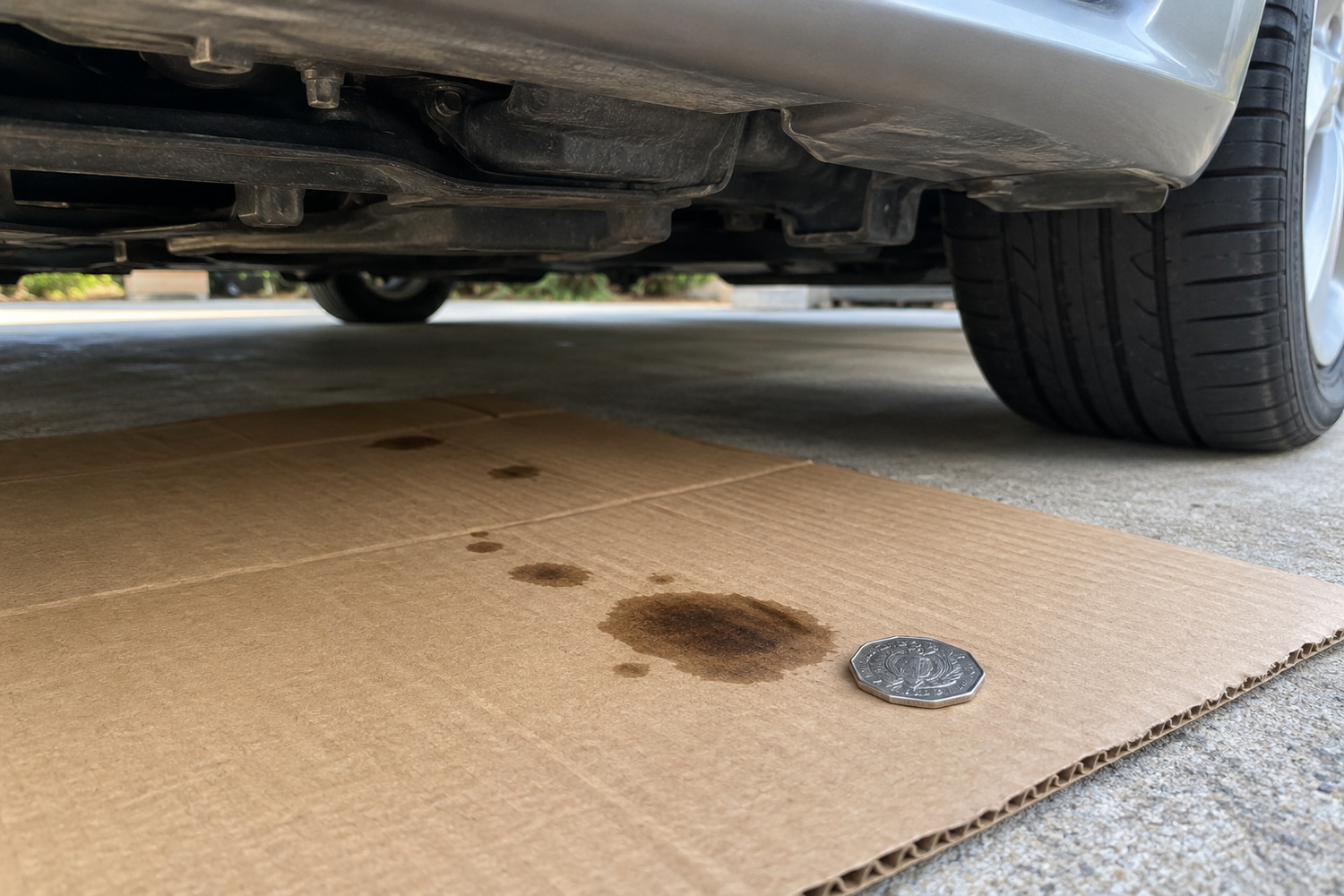
Two checks settle it in the driveway. How big is the patch after a night? A coin-sized mark is a weep, and something spreading is moving faster. Has the temperature gauge moved? Anything above where it normally sits, with a coloured puddle underneath, ends the decision.
How do I find out where the leak is coming from?
You can narrow this down overnight, without tools and without going under the car.
Not every mark is a puddle. Shocks and struts are hydraulic too, so a film of oil down the body of one is that unit leaking, and it points at suspension repairs rather than an engine leak.
Slide a sheet of cardboard under the parking spot before bed, so the drips land where you can read them.
Note where the mark sits against the wheels. Front, middle and beside a wheel are three different answers.
Photograph it next to a coin so the size is on record.
Touch it. Watery, oily and slippery point three different ways.
What a workshop does next
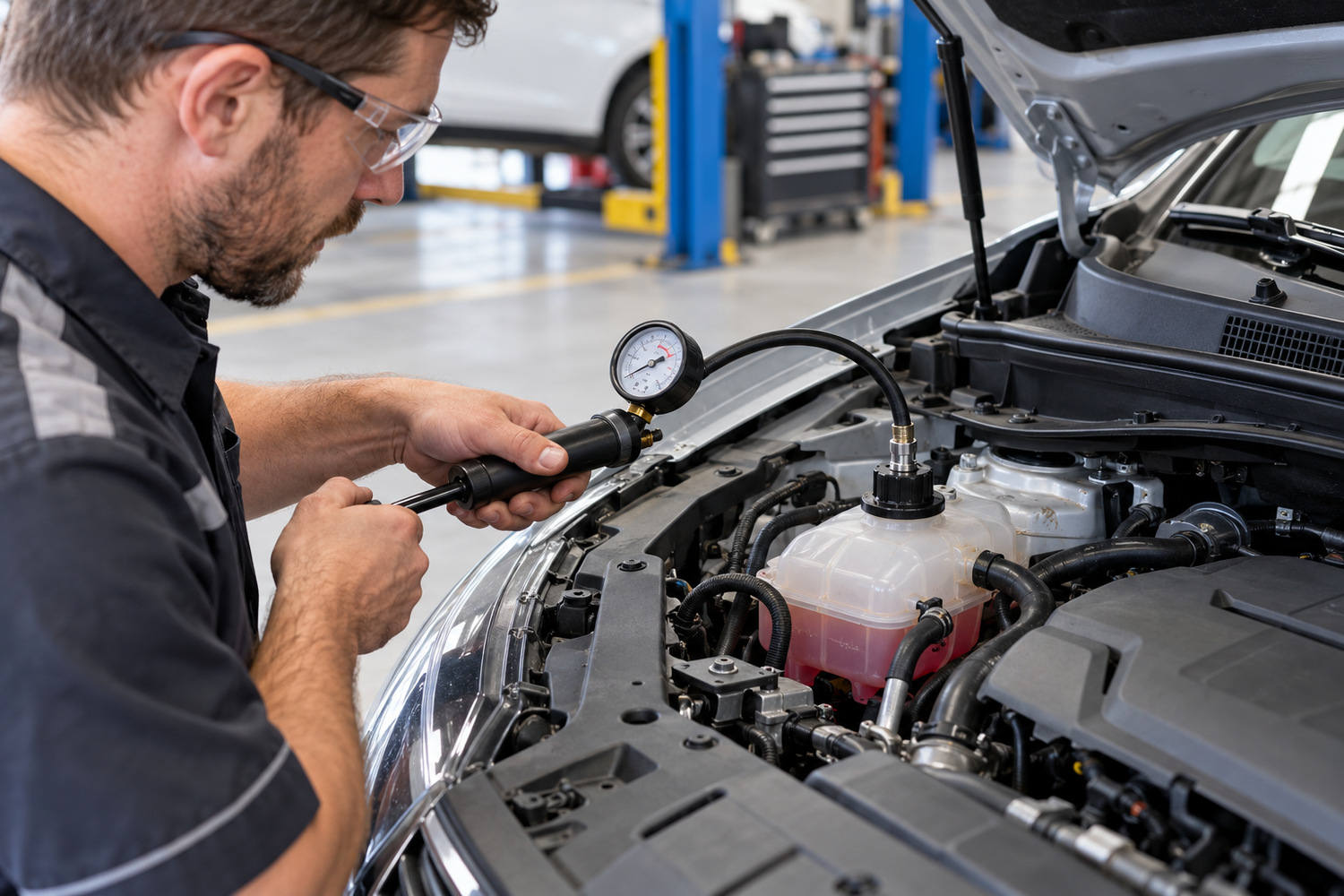
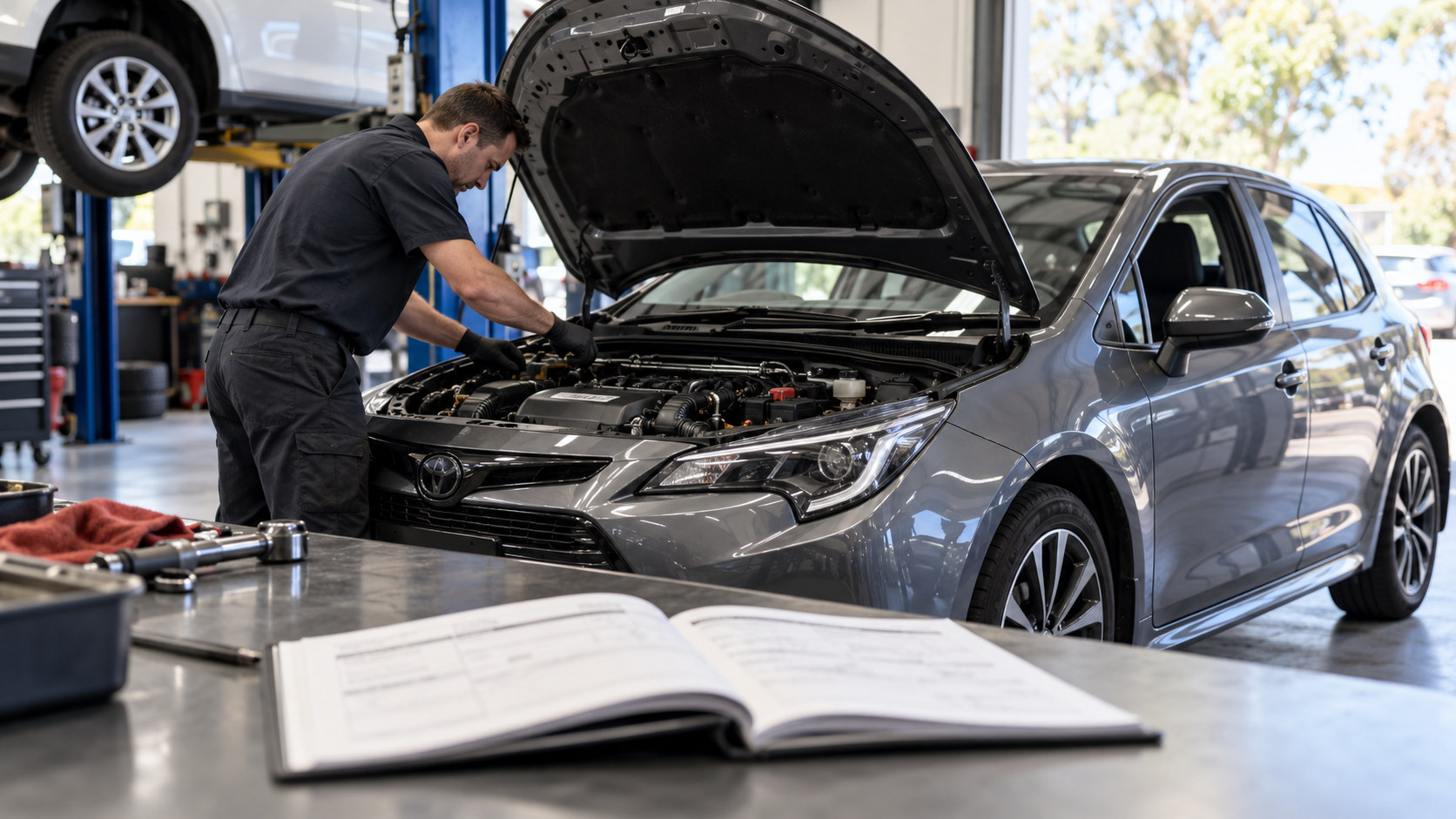
A leak gets traced, not guessed at. A cooling system can be put under pressure while the engine is cold, which pushes a weep into showing itself. That is ordinary cooling system leak detection, and it is a short job. A leak that only appears warm needs a dye in the system and a drive, then the source shows up under a lamp, which means two visits.
“We will keep an eye on it” is a fair answer for a weep that has not changed in months. It is not a fair answer for something dripping while the car is parked, or for anything in the brake or cooling systems.
One thing before any of that. Photograph the patch and leave the levels alone, because what went in the top is the first question anybody asks. The wrong top-up can make a cheap job a dear one: different coolants do not always mix, and some turn to gel. Take the photo, then book a time online with Chandos Auto.
Frequently asked questions
Can I top up the fluid and keep driving?
Topping up hides the leak and the level drops again. The wrong product can also do damage.
What does it cost to find out where a leak is coming from?
That depends on the test. Pressure testing is quick and a dye test takes two visits.
Why doesn’t the colour always tell you what the fluid is?
One colour now covers more than one fluid, and red belongs to the gearbox, the steering and some cooling systems at once.
The quote came in higher than you think the car is worth, and now you have to decide. Comparing those two numbers is where the advice usually starts, and on its own it settles nothing. Here are the three numbers that do, written by the workshop that would be paid for the repair.
You reverse off the driveway and there is a stain on the concrete where the car was. Colour gets you most of the way to what it is, and where it sits under the car gets you the rest. Here is what each one usually means, which two are worth stopping for, and the cardboard trick that finds the source overnight.
You ring up to book a service and the first thing you are asked is which one you want. Nobody explains the question, so most people guess. The short answer is that a logbook service follows the list your manufacturer wrote, a standard service follows the workshop’s own, and which you need comes down mostly to whether the car is still under warranty.
Book for your auto service at the push of a button
Our technicians have worked on almost every vehicle available, which gives them vast experience and enables quick diagnosis of faults or problems saving our customers time and money.
Book a service or RWC certificate inspection today
Need a Roadworthy Certificate?
If you're selling a car, transferring registration, or simply want to make sure your vehicle is safe, you’ll need a valid Roadworthy Certificate (RWC).
At Chandos Auto Repairs, we’re fully licensed to carry out inspections and issue RWCs quickly and professionally.
Protect your sale, protect your safety — book your roadworthy inspection with Chandos today.
Whether it’s time for your next scheduled service or you need a roadworthy certificate, we’re ready to help.
Testimonials
             Posted on Google        Justin Peters     Trustindex verifies that the original source of the review is Google. Excellent service and very efficient work. Highly recommended. Thanks Sarah and team.         Posted on Google        Amy Fowlds     Trustindex verifies that the original source of the review is Google. As a woman who isn't particularly knowledgeable about cars (personally), I've unfortunately had some bad experiences in the past where I felt taken advantage of. That's why I am so incredibly grateful to have found Chandos Auto's! From the moment I walked in, Sarah and Paul were not only welcoming but also transparent with their pricing. They took the time to explain exactly what needed to be done to my car, why it was necessary, and what the costs would be upfront. Their kindness, honesty, and professionalism made me feel confident in their work, and I can’t express how much peace of mind it gives me to know I have a mechanic I can trust and now have as my regular mechanic. I wholeheartedly recommend Chandos Auto's to anyone looking for reliable, honest car service.

Thank you again, Sarah and Paul! My car is running beautifully. :)         Posted on Google        Jen H     Trustindex verifies that the original source of the review is Google. Very friendly, knowledgeable and professional. Explained the work that they performed on my car to me and answered any questions I had. No hidden costs along the way, as I was called and asked prior to anything unexpected being done so I could decide how to proceed. Thank you, I will be returning next service.         Posted on Google        Jack Goulmy     Trustindex verifies that the original source of the review is Google. Great servise and great team! Highly recommend.         Posted on Google        Sendo Liu     Trustindex verifies that the original source of the review is Google. Very helpful, very responsive, very quick         Posted on Google        Freddie Carlstrom     Trustindex verifies that the original source of the review is Google. Stephen from Chando’s took on my roadworthy when no one else would this close to Christmas. Awesome, friendly service with incredible turnaround times. So good to find such a great local mechanic - we’ll be back.         Posted on Google        Sam Giles     Trustindex verifies that the original source of the review is Google. Went and took my Ranger to Chandos for the first time today for a service and have a look at a few things, Steve the legend ran me through everything he did and what to keep an eye on, great to find a local mechanic, cars driving grouse will recommend to all family and friends         Posted on Google        M C     Trustindex verifies that the original source of the review is Google. Best guys ever, needed an inspection done because I was having trouble finding an issue, multiple people/places couldn't but this place had found my problem in 15 minutes. Everyone was kind and friendly, 11/10 service!         Posted on Google        Dustin Carpenter     Trustindex verifies that the original source of the review is Google. I can’t say enough good things about these folks!! I had one day to get 3 days worth of stuff done and they smashed it for me cheaper than I was quoted else where. And they did it while being extremely kind and polite.         Posted on Google        Renae     Trustindex verifies that the original source of the review is Google. Life had thrown massive curveballs and to top it off, I had my elderly fathers car transferred into my name. Original mechanic sick, booked in a panic to another who did not turn up. Last day to keep registration ( I had been waiting for original mechanic- my fault). I rang Chandos and these guys squeezed us in. They were already busy. They were kind, professional, upfront and honest. I will definitely go back to these guys. Very happy. A massive Thankyou